
The closest swap for “for example” is “for instance”, which works in all the same places. In a formal essay, try “to illustrate” or “such as”; in notes and parentheses, use “e.g.”; and in casual writing, “like” or “take” does the job nicely.
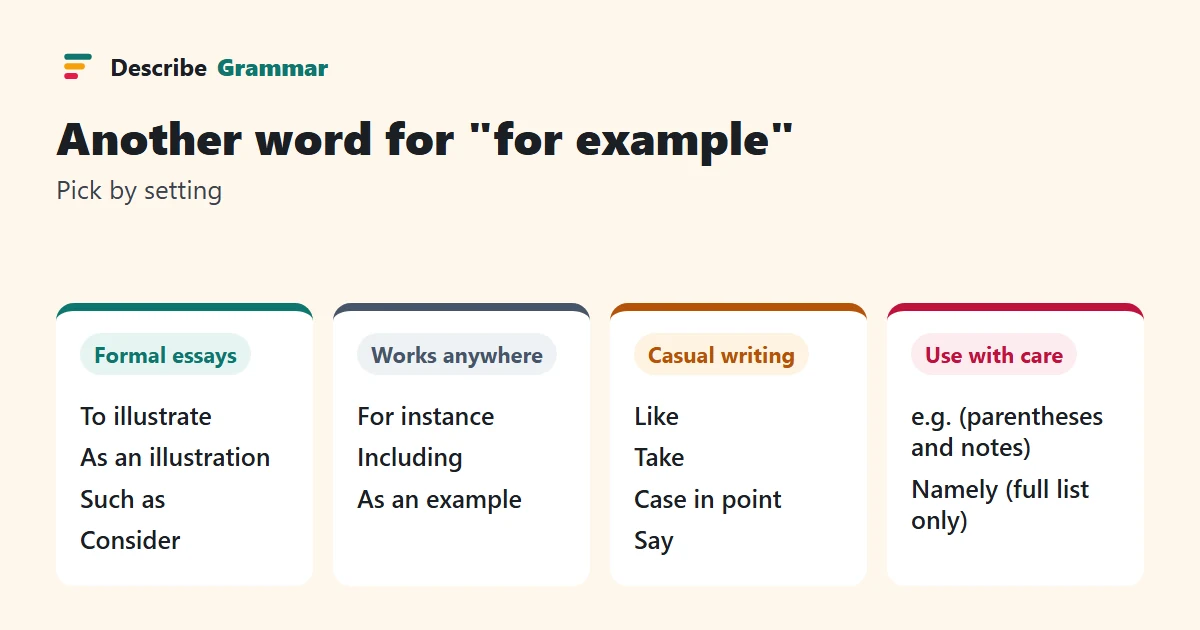
Below you’ll find 16 alternatives, grouped by where they fit in a sentence, with an example for each. You’ll also get the comma rules that trip most people up, a short guide to “e.g.”, and a before-and-after paragraph that shows how to stop repeating yourself.
What “for example” does in a sentence
“For example” tells your reader: here is one case that proves or explains what I just said. It doesn’t claim to give the full list. It just gives a sample.
That small job can happen in three places, and each place has its own punctuation.
1. At the start of a sentence
Put a comma after it.
- Many English words have silent letters. For example, the “k” in “knee” is never pronounced.
2. In the middle, as an interruption
Put a comma on both sides, so the reader can lift it out and the sentence still works.
- Some verbs, for example “go” and “eat”, have irregular past forms.
- A short break, for example, can help you write faster.
3. Before a list at the end of a sentence
Put a comma before it. A comma after it is common too, and it’s never a mistake, so use both if you’re unsure. Just be consistent in one piece of writing.
- Bring something warm, for example, a jacket or a scarf.
Joining two full sentences
If “for example” sits between two complete sentences, a comma alone isn’t enough. Use a semicolon before it (or start a new sentence) and a comma after it.
- Some idioms make no literal sense; for example, nobody actually breaks a leg on stage.
16 alternatives to “for example”, grouped by job
Not every alternative fits every slot. Some can open a sentence; others only work in the middle of one. That’s why the groups below are sorted by job, not just by how fancy they sound.
Straight swaps (work anywhere “for example” works)
- For instance. The twin of “for example”. Same meaning, same commas, equally fine in essays and emails.
Some plants, for instance, close their leaves at night. - e.g. Short for the Latin exempli gratia, “for the sake of example”. Best in parentheses, notes, slides and forms, not in the flowing text of an essay.
Pack light snacks (e.g., nuts or fruit).
Words that lead into a list inside a sentence
These can’t start a sentence on their own. You can’t write “Such as, apples are healthy.” They sit right before the examples.
- Such as. The standard choice in formal writing. No comma after it.
Root vegetables such as carrots and beets keep well in winter. - Including. Signals that your examples are part of a bigger group. Good when the full group is large.
The course covers several skills, including note-taking and summarizing. - Like. Natural and correct, though some teachers still prefer “such as” in essays. Perfect for emails and everyday writing.
Try easy games like chess or checkers. - In particular. Use it when you want to spotlight one example as the most important, not just one of many.
Several towns flooded, and the river villages in particular were hit hard.
Formal openers for a whole example sentence
- To illustrate. Signals a longer example that’s coming. Common in academic writing.
Small habits add up. To illustrate, reading ten pages a day gets you through a 300-page book in a month. - As an illustration. A slightly more formal cousin of “to illustrate”.
As an illustration, consider how a single delayed train can disrupt an entire timetable. - As an example. Plain and clear. Good when “for example” has already appeared twice.
As an example, the word “set” has dozens of dictionary meanings. - One example is / A good example is. Turns the example into the subject of the sentence, which adds variety.
A good example is the way the city redesigned its bus routes. - Consider. Invites the reader to look closely. Works well at the start of a paragraph.
Consider the humble paperclip, which has barely changed in shape for generations. - Specifically. Narrows a general point down to the exact thing you mean. Use it when your “example” is really a precise detail.
The report had one weak section, specifically the budget forecast. - To give one example. Hints that more examples exist but you’re choosing one. Handy in speeches and essays.
Prices have risen across the board. To give one example, a loaf of bread costs noticeably more than it used to.
Casual options (texts, chats, blog posts)
- Take. Friendly and direct, like you’re pointing at something.
Some shows get better with time. Take the second season, which is far stronger than the first. - Case in point. Use it right after someone (or something) proves your point. Slightly playful.
I always forget my umbrella. Case in point: I’m soaked right now. - Say. Spoken-style and relaxed. Put commas around it.
Pick a quick dinner, say, pasta or a stir-fry.
Using “e.g.” without mistakes
“e.g.” is the alternative people get wrong most often, so it earns its own section.
- Write it lowercase with two periods: e.g. Not “eg”, “Eg.” or “e.g” with one dot.
- The comma after it depends on your style. American style guides usually put a comma after “e.g.”; British writers often leave it out. Pick one and stick with it.
- Keep it inside parentheses in formal writing. Many academic styles (APA, for one) allow “e.g.” only in parenthetical material and want “for example” in the running text.
- Don’t end the list with “etc.” “e.g.” already tells the reader there are more. “(e.g., apples, pears, etc.)” says the same thing twice.
- Don’t mix it up with “i.e.” “i.e.” means “that is” and introduces the only thing you mean, not a sample. “Bring a hot drink (e.g., tea)” means tea is one option. “Bring your ID (i.e., your passport)” means the passport and nothing else.
A simple memory trick: e.g. = example given, i.e. = in essence. That’s not what the Latin says, but it points you to the right meaning every time.
Before and after: varying it in an essay
Here’s a paragraph that leans on one phrase too hard:
Cities can reduce traffic in many ways. For example, they can improve bus services. For example, buses could run more often at night. Cycling is also useful. For example, safe bike lanes encourage people to leave the car at home. Some cities have also tried other ideas, for example, car-free Sundays.
Four “for example”s in five sentences. The ideas are fine, but the rhythm is flat. Here’s the same paragraph with varied signals:
Cities can reduce traffic in many ways. One option is better bus services; buses could, for instance, run more often at night. Cycling helps too. To illustrate, safe bike lanes encourage people to leave the car at home. Some cities have also tried bolder ideas, such as car-free Sundays.
Notice what changed. One example became the subject (“One option is”). One became an interruption (“for instance”). One got a formal opener (“To illustrate”). The last one became a short list after “such as”. Each signal matches the shape of its sentence.
You don’t need a new phrase every time. Two or three different signals in a paragraph is plenty. Sometimes the best fix is no signal at all: if the example obviously follows the point, just state it.
Common mistakes and how to fix them
Starting a sentence with “such as” or “like”
Wrong: Many birds migrate. Such as swallows and geese.
Right: Many birds migrate, such as swallows and geese.
“Such as” needs to hang on to the sentence before it. If you want a fresh sentence, use “For example” or “For instance”.
A comma splice around “for example”
Wrong: Some words are tricky, for example, “their” sounds like “there”.
Right: Some words are tricky; for example, “their” sounds like “there”.
Both halves are full sentences, so they need a semicolon or a period between them.
Using “namely” to mean “for example”
“Namely” introduces the complete list, not a sample. “Two students passed, namely Amir and Lucy” means those two and no one else. If there are others, use “such as” or “including”.
Giving a list that isn’t an example of anything
“For example” needs a general point in front of it. “For example, the meeting is at three” doesn’t illustrate anything. If there’s no bigger claim, drop the phrase.
Quick questions
Is “for instance” more formal than “for example”?
No. They mean the same thing and suit the same settings. Many writers alternate between them just to avoid repetition.
Can I use “like” instead of “for example” in an essay?
“Like” is standard English for giving examples, but some teachers and editors prefer “such as” in formal work. If you’re writing for a grade, “such as” is the safe pick.
Can I start a sentence with “e.g.”?
It’s best not to. A capital “E.g.” at the start of a sentence looks clumsy. Write “For example” instead and save “e.g.” for parentheses and notes.
Want more help with essay wording? Browse our writing and essays guides for transitions, linking words and punctuation tips.