
TYSM means “thank you so much.” It’s a quick, warm way to say thanks in a text, a chat or a comment, and it sounds a little more grateful than a plain “ty” or “thanks.”
So if a friend sends “TYSM!!” after you lend them a charger, they’re saying a big, happy thank you. Nothing hidden, nothing sarcastic (most of the time). Below you’ll find how strong it sounds, where it fits, real examples, easy replies, and the few places where you should spell it out instead.
How strong is TYSM?
Think of texting thanks as a little ladder. Each step adds a bit more feeling:
- ty: short and polite. Fine for small things, like someone passing on a link.
- thx or thanks: neutral and friendly.
- tysm: warmer. You’re genuinely grateful, or the favor was bigger than usual.
- tysmmm or TYSM!!!: extra excited. Stretching the last letter or adding exclamation marks turns up the volume.
- thank you so much (written out): the same words, but it reads as more careful and sincere because you took the time to type it.
That last point surprises people. TYSM and “thank you so much” mean exactly the same thing, but the full version feels more personal. When the favor really mattered (someone covered your shift, helped you move, sat with you at the hospital), type the whole thing. Save TYSM for the everyday kindnesses.
Where you’ll see it
TYSM lives anywhere people type fast and casually:
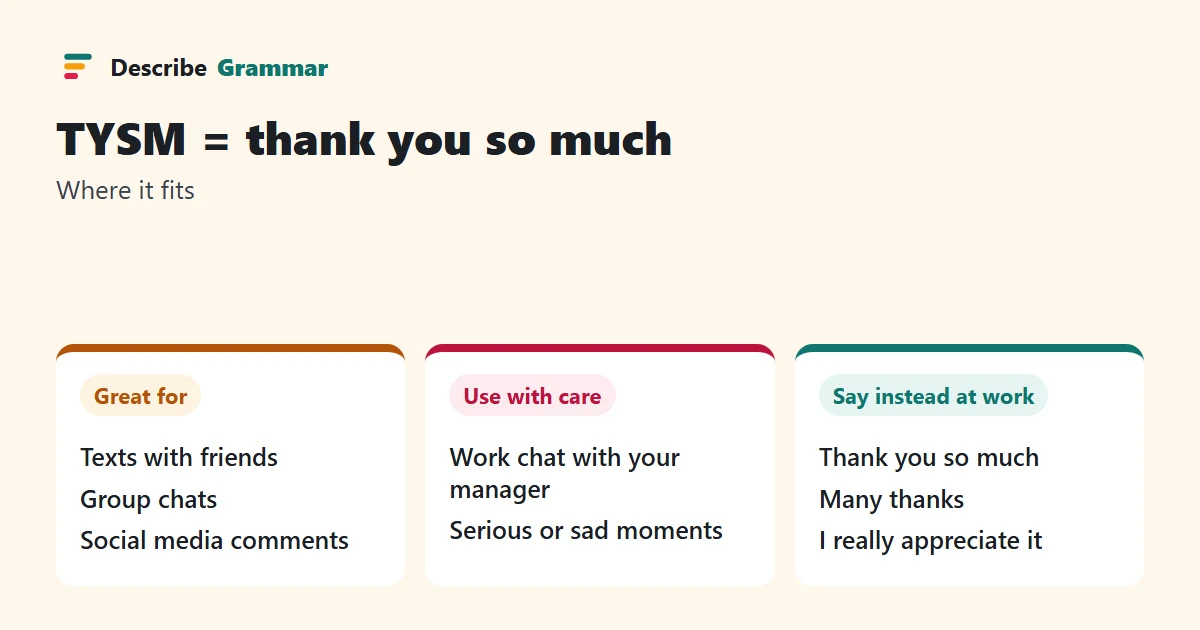
- Text messages and group chats, especially with friends and family.
- Social media comments. A creator might reply “tysm!!” to a nice comment, or you might write it under a friend’s birthday post for you.
- Gaming and online communities, when someone shares a tip or helps you finish a level.
- Casual work chat between teammates who already talk informally.
You’ll see it written both ways, “tysm” and “TYSM.” Both are correct. Lowercase feels relaxed, and capitals can look a touch more enthusiastic, but nobody will read much into the difference.
TYSM in real conversations
Here are a few short exchanges so you can see how it sits in a chat.
Sara: I left your jacket with your neighbor, it was raining
You: omg tysm, I totally forgot it at your place
Group chat: Happy birthday Leo!! 🎉
Leo: TYSM everyone, you made my day
Coworker: I fixed the typo in your slides before the meeting
You: tysm, that would have been embarrassing
Comment on your photo: This is such a beautiful shot
You: tysm! It was taken on my phone, believe it or not
Mom: I put some leftovers in your fridge for tomorrow
You: TYSM Mom, you’re the best
Notice how TYSM usually comes with a little extra: a reason, a joke, or a compliment. On its own it can feel a bit quick. A few more words make it land as real warmth.
How to reply when someone sends you TYSM
You don’t have to reply at all if the chat has naturally ended. But if you want to answer, match their energy. Some easy options:
- “You’re welcome!” Classic and always safe.
- “np” or “no problem”: relaxed, says it was no trouble.
- “Anytime!”: friendly, and it hints you’d happily help again.
- “Of course 😊”: warm, works well with close friends.
- “Glad I could help”: a little more thoughtful, good after a real favor.
- “yw”: short for “you’re welcome.” Very casual, fine with friends who text in shorthand too.
If someone thanks you in a public comment, a heart reaction or a quick “of course!” is plenty.
When TYSM can sound sarcastic
Like any thank you, TYSM can be flipped into sarcasm. If the “favor” was actually unhelpful, the thanks is probably not sincere:
Brother: I told Mom you got a parking ticket
You: wow tysm, really appreciate that
Here nobody is grateful. The clue is the situation, not the letters. If someone thanks you for something that clearly annoyed them, they’re teasing or complaining. With friends it’s usually playful. If you’re not sure, it’s fine to ask, “wait, are you actually upset?”
When to write “thank you” in full instead
TYSM is friendly, but it’s still shorthand. In a few places, it can make you look rushed or too casual:
- Emails to clients, customers or people you’ve never met. Write “Thank you so much” or “Many thanks.”
- Messages to a manager or senior colleague, unless they already text you in shorthand.
- Job applications, interviews and follow-ups. Always the full words.
- Serious or sad moments. If someone sent condolences or helped during a hard time, “Thank you so much, it means a lot” feels far kinder than four letters.
- People who might not know the abbreviation, like an older relative who doesn’t text much, or someone still learning English.
A simple test: would you say “thanks a bunch!” out loud to this person? If yes, TYSM is probably fine. If you’d choose your words more carefully in person, choose them carefully in writing too.
Common mistakes with TYSM
- Using it for a huge favor. It’s not wrong, but it can feel small next to what they did. Add a sentence, or write it in full.
- Mixing it into formal writing. “Dear Ms Patel, tysm for your time” looks odd. Pick one register and stick to it.
- Adding “you” after it. “TYSM you” repeats the “you” that’s already inside the abbreviation. Just “TYSM” is enough.
- Overusing it. If every message you send ends in TYSM, it starts to lose its warmth. Mix in “thanks!”, “appreciate it” or a simple heart.
Similar abbreviations for saying thanks
- TY: thank you.
- THX or TX: thanks.
- TYVM: thank you very much. Same strength as TYSM, a little less common.
- TIA: thanks in advance. Used when you ask for something before the person has helped, like “Can someone send me the notes? TIA.”
- ILYSM: I love you so much. A close cousin, used between partners, family or very close friends.
Want to decode more chat shorthand? Our texting slang guides explain what each one means and how to reply without feeling lost.
Quick questions about TYSM
Is TYSM rude?
No. It’s a friendly, positive word. The only risk is using it where people expect a full “thank you,” such as a formal email.
Is TYSM flirty?
Not by itself. It’s just thanks. If it comes with lots of hearts or a compliment, the flirting is in the extras, not in TYSM.
How do you pronounce TYSM?
Technically you could say the letters, “tee why ess em,” but most people just read it as “thank you so much” in their head and say the full phrase out loud.
That’s really all there is to it. TYSM is a little burst of gratitude, so use it freely with friends, and type out the full words when the moment deserves a bit more care.