
The best alternatives to “just a friendly reminder” are plain and specific: “Quick reminder that…”, “Following up on…” or “Checking in on…”, followed by exactly what you need and when. They do the same job without the extra padding that can make the original sound passive-aggressive.
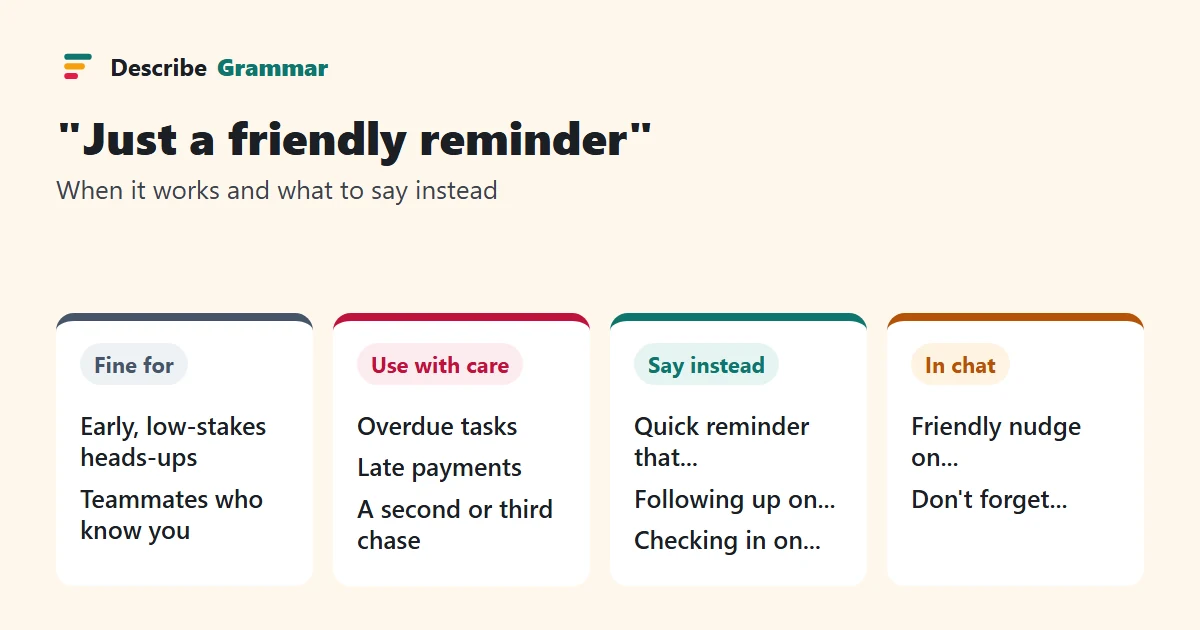
Below you’ll find why the phrase sometimes lands badly, 16 alternatives sorted by tone, three sample emails you can adapt, and what to say when someone sends you a “friendly reminder”.
Is “just a friendly reminder” rude?
No, not on its own. Plenty of people use it kindly, and many readers take it at face value. It’s grammatically fine and polite on paper.
The trouble is how often it shows up right after something went wrong. A missed deadline, an unpaid invoice, a form nobody filled in. Because of that, a lot of readers have learned to hear it as “I already told you this, and I’m annoyed.” That’s why it turns up in so many office jokes.
Two small words do most of the damage:
- “Just” shrinks the request. It tries to sound casual, but it can read as “this is so simple, why haven’t you done it?”
- “Friendly” announces your tone instead of showing it. When you have to tell someone you’re being friendly, they start to wonder whether you are.
So the phrase is safest when the reminder really is early and harmless, like a heads-up about tomorrow’s meeting. It’s riskiest when you’re chasing something overdue, because that’s exactly when the reader is already feeling a little guilty.
16 better ways to say “just a friendly reminder”
Pick the group that matches your situation, then the line that sounds most like you. Each one comes with an example you can borrow.
Warm and light (early reminders, teammates, clients you like)
- Quick reminder that…
“Quick reminder that the team lunch is at noon tomorrow.”
The closest swap. Short, neutral, no hidden edge. - A heads-up that…
“A heads-up that the office closes early on Friday.”
Great for information people will be glad to have. - Just so it’s on your radar…
“Just so it’s on your radar, the survey closes Thursday.”
Friendly and relaxed. Here “just” softens rather than scolds, because nothing is late. - In case it slipped through…
“In case it slipped through, here’s the link to Monday’s agenda again.”
Gives the reader an easy, face-saving reason. - Bumping this to the top of your inbox
“Bumping this to the top of your inbox, as I know things get busy.”
Light and modern. Better for colleagues than for senior clients.
Neutral and professional (most work email)
- Following up on…
“Following up on my email from Tuesday about the venue booking.”
The workhorse of polite follow-ups. Clear and calm. - I’m checking in on…
“I’m checking in on the draft contract we discussed last week.”
Sounds interested rather than impatient. - As a reminder,…
“As a reminder, timesheets are due by 5 p.m. on Friday.”
Good for group emails and routine deadlines. - I wanted to remind you that…
“I wanted to remind you that your parking permit expires at the end of the month.”
A little more personal than “As a reminder”. - Could you give me an update on…?
“Could you give me an update on the budget figures?”
Turns the reminder into a simple question, which is easy to answer.
Firm but polite (overdue items, second or third follow-up)
- I’m following up again on…
“I’m following up again on invoice 4410, which was due last Friday.”
“Again” signals persistence without any sarcasm. - This is now overdue, so…
“This is now overdue, so could you let me know when payment will be made?”
States the fact plainly. Honest is kinder than coy here. - To keep things on schedule, I need…
“To keep the launch on schedule, I need your sign-off by Wednesday.”
Explains why it matters, which motivates more than nagging does. - Please let me know by [date]…
“Please let me know by Monday whether you can attend.”
A clear deadline is the most helpful thing a reminder can contain.
Casual (chat apps, texts, close coworkers)
- Friendly nudge on…
“Friendly nudge on the slides when you get a sec!”
Playful. Fine in chat; a bit too cute for a formal email. - Don’t forget…
“Don’t forget we’re meeting at the café, not the office.”
Direct and warm between people who know each other well.
Sample emails using these alternatives
Here’s how the options look in a full message. Notice that each one names the task, the date, and one easy next step.
1. An early reminder to a team
Subject: Quick reminder: training session Thursday
Hi all,
Quick reminder that the safety training is this Thursday at 10 a.m. in Room 3. It takes about an hour, so please bring a laptop.
If you can’t make it, reply to this email and I’ll book you into the next one.
Thanks,
Priya
2. A follow-up when you’re waiting on someone
Subject: Following up: photos for the brochure
Hi Tom,
Following up on my note from last week about the product photos. In case it slipped through, I’ve attached the shot list again.
Could you send the files by Wednesday? That gives the designer two days before the print deadline.
Thanks so much,
Ana
3. A firm reminder about a late payment
Subject: Invoice 4410 now overdue
Dear Ms Grant,
I’m following up again on invoice 4410 for the website work, which was due on the 15th. I’ve attached a copy for your records.
Could you let me know when we can expect payment? If there’s an issue with the invoice, I’m happy to sort it out.
Kind regards,
Daniel
None of these needs the word “friendly”. The tone comes from the details: a reason, a date, an offer to help.
How to reply to “just a friendly reminder”
Whatever you suspect about the sender’s mood, reply as if they meant it kindly. It keeps things calm and makes you look good.
- If you’ve done it: “Thanks for the reminder. I sent it this morning, so it should be in your inbox.”
- If you’re on it: “Thanks for checking in. I’ll have it to you by Thursday afternoon.”
- If you forgot: “Thank you for the nudge, this one slipped past me. I’ll get it done today.”
- If you need more time: “Thanks for the reminder. I’m waiting on figures from finance, so could we say Monday instead?”
Keep it short, give a date, and skip the long apology. One honest sentence and a plan is all the sender wants.
Tips for reminders that don’t sound annoyed
- Lead with the task, not the reminder. “The report is due Friday” is clearer than three lines of warm-up.
- Include everything needed to act. Re-attach the file, paste the link, repeat the deadline. Don’t make people dig through old threads.
- Drop “just” when something is late. On an overdue item it can sound like an eye roll. Say what you need plainly.
- Avoid “as per my last email”. It’s even sharper than “friendly reminder” and almost always reads as irritation.
- Give a reason when you can. “So the printer has time” or “so payroll runs on time” turns a nag into teamwork.
- Space out your follow-ups. A few working days between reminders feels patient. Daily chasers feel like pressure.
For more phrases like these, browse our work email guides.
Quick questions
Can I still use “just a friendly reminder”?
Yes. If the reminder is early, low-stakes and goes to people who know you’re friendly, it’s fine. Avoid it when something is already late, because that’s when it’s most likely to be read as sarcasm.
Is “gentle reminder” better?
It’s common, especially in some workplaces, and it’s perfectly polite. It has the same small risk as “friendly”, since it describes your tone instead of showing it. “Quick reminder” is the safer neutral choice.
What should the subject line say?
Name the thing, not the feeling. “Reminder: timesheets due Friday” or “Following up: venue booking” tells the reader what to do before they even open the email.