
Quick answer
The word you almost certainly want is courtesy, with an "o" after the "c": c-o-u-r-t-e-s-y. "Curtesy" is a real word, but it's a rare old legal term about a widower's right to his late wife's land, so in everyday writing it's a misspelling.
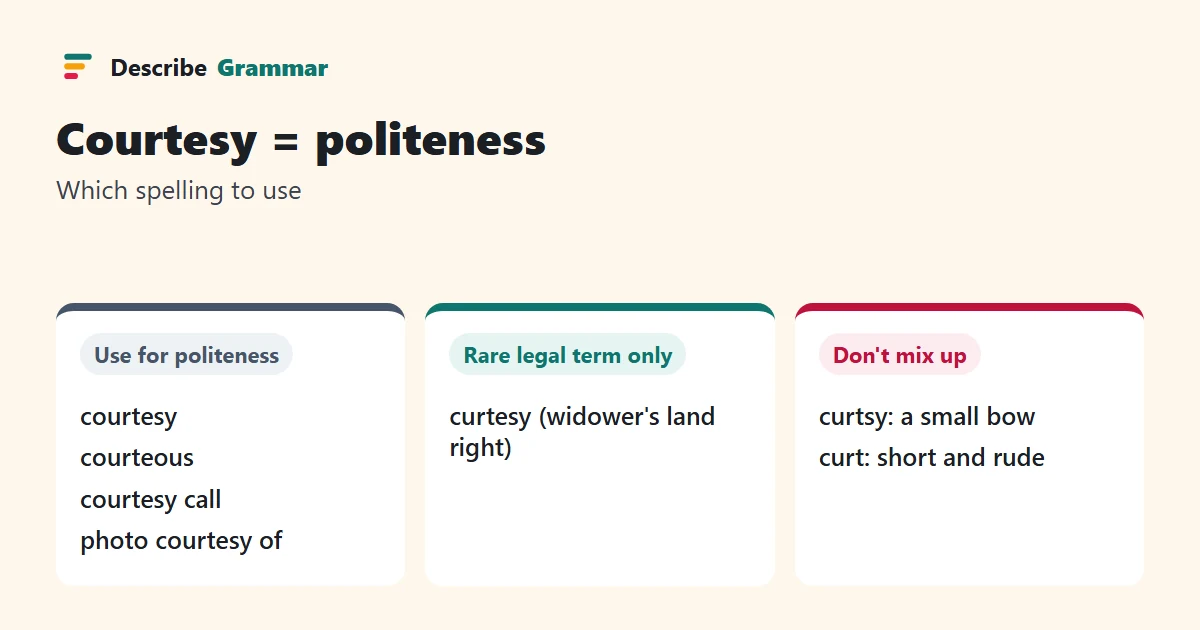
If you’re writing “thank you for your courtesy”, “a courtesy call” or “photo courtesy of the museum”, there’s one spelling you want. Below you’ll find what each word means, why the mix-up is so common, two easy memory tricks, and a short practice round to lock it in.
“Thank you for your courtesy.”
“Thank you for your curtesy.”
Courtesy: the everyday word
Courtesy means polite, respectful, considerate behavior. It can also mean a single polite act, or something given as a favor. It’s a noun, and its plural is courtesies.
Here’s how it shows up in real sentences:
Good manners: “The nurse treated every patient with courtesy.”
A polite act: “As a courtesy, we’ll send you a reminder the day before.”
Common courtesy: “It’s common courtesy to reply when someone invites you.”
Out of courtesy: “I copied her in out of courtesy, even though she doesn’t need to act.”
Courtesy of (given by): “Lunch today is courtesy of the sales team.”
Credit lines: “Photo courtesy of the city library.”
It also works like an adjective in front of another noun, meaning “done to be polite” or “provided free”:
| Phrase | Meaning |
|---|---|
| Courtesy call | A short, friendly call or visit with no hard business attached. “The new manager made courtesy calls to our biggest clients.” |
| Courtesy car | A car lent to you for free, often while yours is being repaired. |
| Courtesy copy | A copy sent to someone for their information. |
| Courtesy reminder | A polite nudge before a deadline. |
If you write courtesy reminders a lot, our guide to other ways to say “just a friendly reminder” has gentler and firmer versions.
Curtesy: the rare legal word
Curtesy (no “o”) is an old common law term. It named a husband’s right, after his wife died, to keep a life interest in land she had owned. Traditionally it only applied if the couple had a child born alive who could inherit that land. The matching right for a widow was called dower.
You may also see the fuller phrase “tenancy by the curtesy”. Honestly, though, you’re unlikely to need any of it. England abolished curtesy long ago, and most US states have abolished it or replaced it with rules that treat husbands and wives the same way. It survives mainly in law textbooks, history of property law, and old deeds and court records.
Quick test
If your sentence isn’t about a dead spouse’s land and old inheritance law, “curtesy” is the wrong word.
Why so many people write “curtesy”
You’re in good company if you’ve typed it. There are three good reasons.
The “o” is silent
Most people say courtesy as “KUR-tuh-see”. The first syllable sounds exactly like “cur” or “curt”. Nothing in the sound tells you there’s an “o” hiding in there, so spelling it the way it sounds gives you “curtesy”.
“Curt” is a real word nearby
“Curt” means short and slightly rude (“a curt reply”). Your brain knows that spelling, so it grabs it. The irony is lovely: a curt reply is the opposite of courtesy.
Spell checkers may not catch it
Because “curtesy” appears in larger dictionaries as the legal term, a spell checker may let it through. The word is spelled correctly; it’s just the wrong word. That’s why it slips into emails and even printed signs.
Two memory tricks that work
Memory trick 1: courtesy belongs in court
The word grew out of courteous, which comes from the behavior expected at a royal court. Courtiers were supposed to be polished and polite. So courtesy starts with court: c-o-u-r-t. If you can spell “court”, you can spell courtesy.
Memory trick 2: “our” manners
Courtesy has “our” in it: c-our-tesy. Think “courtesy is how we show our respect”. Courteous has it too: c-our-teous.
Pick whichever one sticks. Most people only need one.
The courtesy word family (and one sneaky cousin)
Once you know the “court” spelling, the whole family falls into place:
| Word | Type | Example |
|---|---|---|
| courteous | Adjective: polite and respectful | “The driver was courteous and patient.” |
| courteously | Adverb | “She courteously held the door.” |
| discourteous | Adjective: rude | “Leaving without a word felt discourteous.” |
| discourtesy | Noun: an impolite act | “Ignoring the invitation was a small discourtesy.” |
| courtesies | Plural noun | “We exchanged the usual courtesies before the meeting began.” |
And the sneaky cousin: curtsy (also spelled curtsey). That’s the little bow where you bend your knees, often with one foot behind the other. It actually comes from “courtesy”, which is why the words look alike. So you now have three words that sound close:
| Spelling | Meaning |
|---|---|
| courtesy | Politeness (the one you’ll use most) |
| curtsy or curtsey | A small bow |
| curtesy | The old legal right of a widower |
Want more pairs like this? Browse our spelling and word choice guides.
A tone note on “courtesy” phrases
The word itself is warm, but a few phrases built on it can land with an edge. It helps to know which ones.
Friendly Safe to use
As a courtesy
“As a courtesy, I’ve attached last month’s figures too.”
Friendly and professional.
Thank you for your courtesy
“Thank you for your courtesy during the inspection.”
Polite and a little formal. It suits a letter or a customer service email.
Use with care Can sound like a telling-off
Common courtesy
“It’s just common courtesy to reply.”
Neutral when you describe a norm (“It’s common courtesy to knock”). Aimed at a person, it may read as “you were rude”.
Do me the courtesy of…
“Please do me the courtesy of reading my email before replying.”
The one to watch. It’s correct, but it sounds cold and annoyed. If that’s not the mood you want, try “Could you take a look at my full email when you get a chance?”
Here’s a short email that uses the word well:
Hi Daniel,
As a courtesy, I wanted to let you know that the office will be closed on Friday for maintenance. Your booking for Monday is not affected.
Thanks for your patience, and have a great weekend.
Notice how “as a courtesy” signals “you don’t strictly need this, but I thought you’d like to know”. That’s the word doing its best work.
Quick recap
- Use courtesy for politeness, polite acts, free extras and credit lines.
- Curtesy is a real but rare legal term about a widower’s right to his late wife’s land. Outside that topic, it’s a mistake.
- Courtesy starts with court, and it has our in the middle.
- The bow is a curtsy, and the polite adjective is courteous.
Get the “court” part right and the rest of the word takes care of itself.
Practice
Quick check · 0 / 5
1. "Thank you for the ___ of a quick reply." Which spelling is right?
2. "Under the old rule, the widower held the land by ___ for the rest of his life." Which word fits?
3. "She gave a small ___ when the guests arrived." Which word fits?
4. "The driver was very ___." Which spelling is correct?
5. "The hotel offers a free courtesy shuttle to the airport." Is this correct?
See also

Written and checked by the Describe Grammar editorial team. Every example is written for this page. Tone labels follow our editorial standards. Spotted a mistake? Tell us and we will fix it.