
Quick answer
"Hope you're having a good day" is a polite, friendly line, and it's fine in most emails and texts. For something fresher, pick one of these.
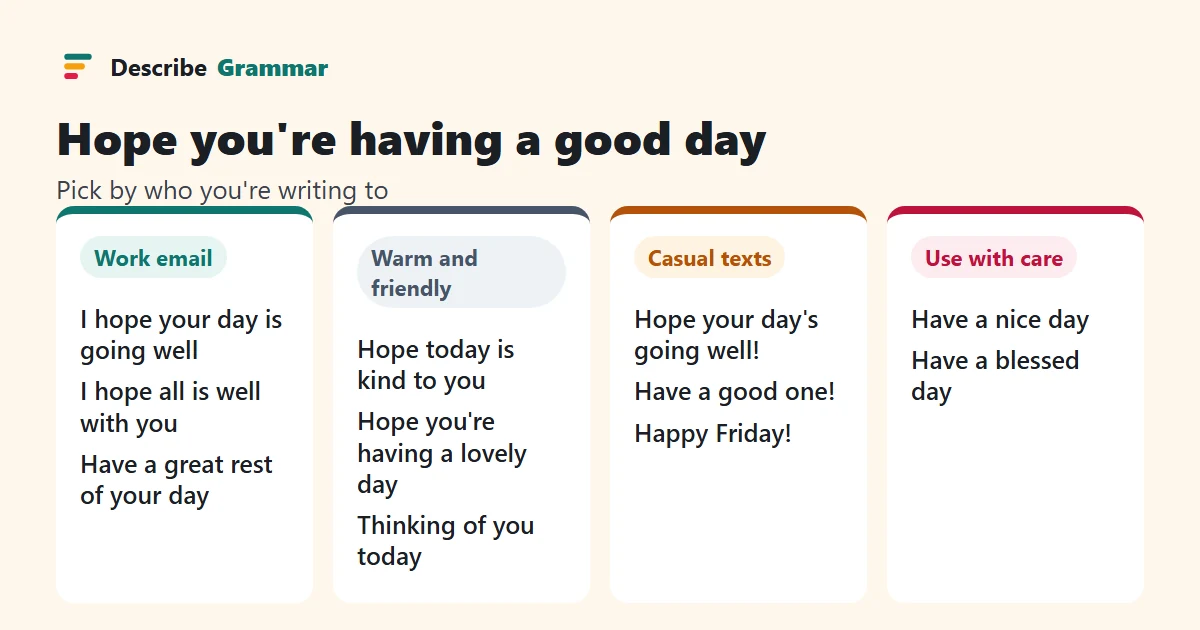
A kind line at the top of a message sets the mood for everything after it. Below you’ll find when “hope you’re having a good day” works, alternatives sorted by tone, a few ready-to-use messages, and simple ways to reply when someone says it to you.
Is “hope you’re having a good day” polite?
Yes. It’s a kind, low-pressure wish. It doesn’t ask the reader for anything, which is why it works so well as a warm-up line before a request.
It’s a little casual for very formal writing, like a cover letter or a first message to a senior executive you’ve never met. In everyday work email, though, nobody will think twice.
When it can fall flat
- When you know their day is bad. If a colleague just told you their flight was canceled, “Hope you’re having a good day” can sound like you didn’t read their message. Acknowledge the problem instead.
- When it opens every single email. Used on autopilot, it starts to feel like a template. People notice when the same line greets them every time.
- Right before bad news. “Hope you’re having a good day! Unfortunately, your order was canceled” reads a bit cruel. Lead with the news and save the warmth for the end.
- When your email lands in their evening. Across time zones, “I hope you’ve had a good day” fits better.
A quick grammar note
“Hope you’re having a good day” is a shortened form of “I hope you’re having a good day.” Dropping the “I” is normal in friendly messages. Keep it in formal ones.
Watch the spelling, too. It’s you’re (you are), not your. This is one of the most common slips in quick texts.
“Hope your having a good day.”
“Hope you’re having a good day.”
19 alternatives, sorted by tone
Pick the group that matches who you’re writing to, then the line that sounds most like you.
Professional Work email
These feel polished without being stiff. Use them as an opening line after “Hi Sam,” or as a closing line before your name.
I hope your day is going well.
“Hi Priya, I hope your day is going well. I’m following up on the invoice we discussed.”
The safest all-round choice.
I hope this message finds you well.
“I hope this message finds you well. I’m writing to introduce myself and our team.”
Classic and formal, best for first contact. It can sound stock, so skip it with people you email every day.
I hope your week is off to a good start.
“I hope your week is off to a good start. Could you review the draft by Thursday?”
Great on a Monday or Tuesday.
I hope all is well with you.
“It’s been a while since we spoke, and I hope all is well with you.“
A touch more personal. Nice for a client you haven’t heard from in some time.
Wishing you a good rest of the day.
“Thanks again for your help. Wishing you a good rest of the day.“
A neat sign-off.
I hope you’ve had a productive day.
“I hope you’ve had a productive day. Here’s the summary from this afternoon’s call.”
Fits an end-of-day email to a teammate. Skip it with customers, because “productive” is all about work.
Warm Friends, family and close colleagues
These carry a little more feeling.
Hope your day is treating you well.
“Hey Leo, hope your day is treating you well!“
Friendly, with a light, playful twist.
Hope you’re having a lovely day.
“Hope you’re having a lovely day. The photos from Sunday are attached!”
Softer and warmer than “good.”
Hope today is kind to you.
“Big day with the doctor, I know. Hope today is kind to you.“
Gentle. Perfect when someone has a stressful day ahead.
Hope your day is full of good things.
“Happy birthday, Nina! Hope your day is full of good things.“
Cheerful, and lovely in a card.
Thinking of you today.
“No need to reply. Just thinking of you today.“
Quiet and caring. Good for someone going through a hard time, since it doesn’t pretend everything is fine.
Casual Texts and chat
Hope your day’s going well!
“Hope your day’s going well! Still on for dinner?”
The everyday version.
Have a good one!
“Thanks for the ride. Have a good one!“
Very common in spoken American English, and easy to type.
Hope today’s been good to you.
“Hope today’s been good to you. Want to call later?”
Relaxed. Good for an evening check-in.
Happy Friday!
“Happy Friday! Any fun plans?”
Let the day of the week do the work.
Hope you’re crushing it today.
“First day at the new job! Hope you’re crushing it today.“
Upbeat. For a friend with a big day.
Use with care Lines that can land differently
These aren’t wrong, but they can land differently than you mean.
Have a nice day.
Polite, but it’s what a cashier says at the register, so in writing it can feel flat. As the last line of a disagreement, it can even sound like a door closing. Fine for short, friendly exchanges.
Hope you’re having a better day than me!
Funny with friends. At work, it drops your bad mood into someone else’s inbox.
Have a blessed day.
Warm and sincere for many people, but it has a religious flavor. Use it when you know the reader welcomes that.
Sample messages
Work email: a gentle follow-up
Subject: Checking in on the proposal
Hi Dana,
I hope your week is off to a good start. I wanted to check whether you had a chance to look at the proposal I sent on Friday. If it helps, I’m happy to walk you through it on a quick call.
Thanks, and have a great rest of your day.
Alex
Notice the wish comes once at the top, and the closing line is different. For more ways to nudge someone without sounding pushy, see our guide to other ways to say “just a friendly reminder”.
Text to a friend before a big moment
Good luck at the interview! Hope today is kind to you. Text me after?
Text to a parent
Hi Mom, hope your day’s going well. Just thinking of you. Call you tonight?
How to reply when someone says it to you
Keep it short and send the wish back. You don’t need to describe your whole day.
At work: “Thanks, Priya, it’s going well. I hope yours is too.” Then answer the actual question in their email.
With friends: “Aw, thank you! It’s been a good one so far. How’s yours?”
Quick text: “Thanks, you too!” With close friends, a short “tysm” works as well (here’s what TYSM means if you’ve seen it and wondered).
If your day is actually rough: You can be honest with friends: “Thanks, it’s been a long one, but your message helped.” At work, a simple “Thank you, I hope yours is going well” is enough.
Tips for using it well
- Use it once. Put the wish at the start or the end of a message, not both.
- Match the time of day. Morning: “I hope your day is off to a good start.” Afternoon: “I hope your day is going well.” Evening: “I hope you’ve had a good day.”
- Get to the point next. After the wish, say why you’re writing in the very next sentence. The friendly line is the doorway, not the room.
- Make it specific when you can. “Hope the move went smoothly” beats a general wish because it shows you remembered.
- Mind the punctuation. It’s a statement, not a question, so it ends with a period or an exclamation mark. The exclamation mark makes it sound brighter.
Looking for more kind words for friends and coworkers? Browse our thanks and wishes guides.
Practice
Quick check · 0 / 5
1. It's Monday morning and you're emailing a client. Which opener fits best?
2. A colleague just told you their flight was canceled. What should you write?
3. Which sentence is spelled correctly?
4. Your email will land in the reader's evening. Which line fits?
5. A friend is going through a hard time. Which message is kindest?
FAQ
Is “I hope you are having a good day” grammatically correct?
Yes. It’s a complete, correct sentence. The present continuous (“are having”) fits because the day is still going on. If the day is over, switch to “I hope you had a good day” or “I hope you’ve had a good day.”
Is it okay to start a work email with it?
Yes, for most workplaces. With someone you’ve never written to, “I hope this message finds you well” or a direct first line is a little more formal. With teammates, a short “Hope your day’s going well” is perfectly friendly.
Should I say “good day” or “great day”?
Either works. “Great” sounds a little more enthusiastic, which suits friends and upbeat messages. “Good” is calmer and fits almost anywhere.
See also

Written and checked by the Describe Grammar editorial team. Every example is written for this page. Tone labels follow our editorial standards. Spotted a mistake? Tell us and we will fix it.