
Quick answer
It's a polite, formal way to ask for something, and it's perfectly correct. For a warmer or more direct email, try one of these.
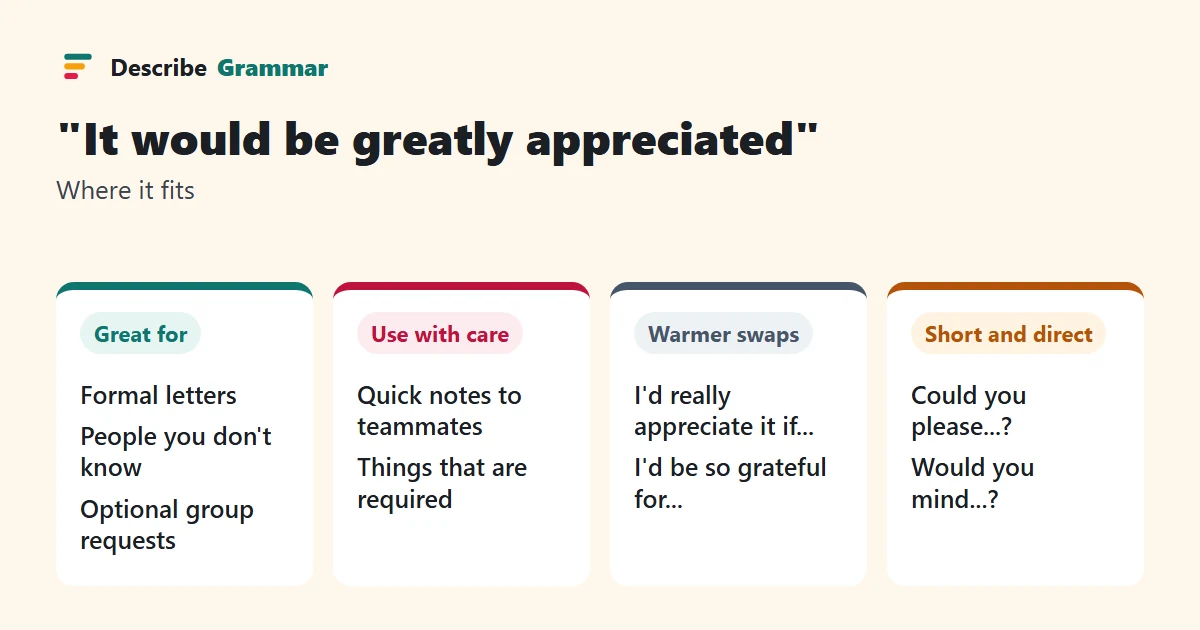
“It would be greatly appreciated” shows up in emails, letters and notices every day, and it’s perfectly correct. It’s just a little distant, because nobody in the sentence is doing the appreciating. Below you’ll see when it fits, when to swap it out, and 18 alternatives you can drop straight into an email.
What the phrase really says (and how it can sound)
“It would be greatly appreciated if you could send the file” means “Please send the file, and I’ll be grateful.” Simple enough.
The grammar is passive: it would be appreciated, but by whom? That missing “I” is what makes the phrase sound official. Sometimes that’s exactly right. Other times it puts a little distance between you and the reader.
Here’s a quick guide to how it lands:
- Sounds right: formal letters, emails to people you don’t know, requests to a whole group, and notices from an organization (“Your feedback would be greatly appreciated”).
- Sounds stiff: a quick note to a teammate you talk to every day. “It would be greatly appreciated if you could pass the stapler” is funny for the wrong reasons.
Usage note
It can sound like pressure when the thing isn’t really optional. “It would be greatly appreciated if all staff completed the training by Friday” can feel like an order dressed up as a favor. If it’s required, it’s kinder to say so.
18 alternatives, sorted by how you want to sound
Pick the group that matches the request, then the line that sounds most like you. Each one comes with an example you can borrow.
Formal Letters, first contact and company email
I would be grateful if you could…
“I would be grateful if you could confirm the dates by Friday.”
A classic for formal letters and first contact.
I would greatly appreciate…
“I would greatly appreciate your feedback on the proposal.”
Same meaning as the original, but you own it.
Your help with this would be much appreciated.
“Your help with the visitor schedule would be much appreciated.”
Keeps the formal feel while naming the specific help.
We would appreciate it if you could…
“We would appreciate it if you could return the signed form.”
Good when you write for a team or a company.
Thank you in advance for…
“Thank you in advance for reviewing the attached report.”
Polite and efficient, though some readers find it a touch presumptuous, so save it for routine requests.
Warm Personal requests and favors
I’d really appreciate it if you could…
“I’d really appreciate it if you could look over my slides before Monday.”
The friendliest direct swap.
It would mean a lot if…
“It would mean a lot if you could come to the farewell lunch.”
Best for personal favors, not for routine tasks.
I’d be so grateful for…
“I’d be so grateful for any tips on the client meeting.”
Warm and humble.
You’d be helping me out a lot if…
“You’d be helping me out a lot if you could cover my shift on Saturday.”
Honest about the favor.
Thanks so much for any help with this.
“I’ve attached the brief. Thanks so much for any help with this.“
Puts the thanks at the end, where it closes the email nicely.
Direct Short asks and quick notes
Could you please…?
“Could you please send me the updated figures?”
Clear, polite, and impossible to misread.
Would you mind…?
“Would you mind checking the second paragraph?”
Soft and easy to say yes to.
Please could you…
“Please could you add Sam to the invite?”
More common in British English.
Can you…? Thanks!
“Can you share the link when you get a chance? Thanks!“
Relaxed, for chat or close colleagues.
Much appreciated.
“Here’s the draft. Comments by Thursday would be much appreciated.”
A compact closer.
Required When it isn’t really optional
Please make sure…
“Please make sure your expenses are submitted by the 5th.”
Clear without being harsh.
You’ll need to…
“You’ll need to complete the safety course before your start date.”
Honest about the rule.
We need … by [date].
“We need everyone’s availability by Wednesday so we can book the room.”
Gives the reason, which earns goodwill.
Before and after: three quick rewrites
Seeing the change side by side helps. Each “after” keeps the politeness but sounds more like a person.
| Instead of | Try | Why it works |
|---|---|---|
| It would be greatly appreciated if you could send the invoice. | Could you please send the invoice when you have a moment? Thank you! | Same politeness, with a person behind it. |
| Any assistance would be greatly appreciated. | I’m stuck on step three of the setup. Any tips would be a big help. | Says what you’re stuck on, so people know what to offer. |
| It would be greatly appreciated if all staff could attend. | Please come along if you can. It’s the only update before the summer break. | Gives a reason to come. |
Notice the second rewrite. “Any assistance” is vague, so people don’t know what to offer. Saying what you’re stuck on gets you better help.
Sample emails
Here’s how the options look in a full message, from a first contact to a quick favor.
Asking someone you’ve never met
Subject: Request for the conference program
Dear Ms. Okafor,
I’m organizing a group booking for next month’s conference and would be grateful if you could send the full program. It will help us decide which sessions our team attends.
Thank you for your time.
Best regards,
Leila Haddad
Asking a colleague for a favor
Subject: Could you look at my slides?
Hi Marcus,
I’d really appreciate it if you could look over my slides before Monday’s pitch. You know the client better than I do, so even a few quick comments would help a lot.
Thanks so much,
Jen
Asking a group for something optional
Subject: Two minutes of feedback?
Hi everyone,
Thanks for coming to the workshop. If you have two minutes, your feedback on the form below would be greatly appreciated. It helps us plan the next one.
All the best,
The training team
That last one shows where the original phrase still shines: an optional request to a group, written on behalf of a team.
Common mistakes to avoid
Watch out for
- Dropping the “-d”. It’s “would be greatly appreciated“, never “appreciate” in this pattern.
- Doubling up. “It would be greatly appreciated if you could kindly please…” piles on politeness until it sounds nervous. One polite word is enough.
- Using “highly appreciated” as a request. You’ll see it, but in American and British English “greatly appreciated” or “much appreciated” sounds more natural for asking a favor.
- Hiding a deadline. If you need it by Friday, say Friday. Politeness doesn’t help if the reader misses the date.
- Using it to soften something mandatory. Readers notice. Be clear about what’s required and save the gratitude for the thank-you.
Chasing a request that went unanswered? Our guide to other ways to say “just a friendly reminder” has follow-up lines that stay polite. And if you’re starting the email with small talk, see other ways to say “hope you’re having a good day”. You’ll find more in our work email section.
Practice
Quick check · 0 / 5
1. You're asking a teammate you talk to every day for a quick favor. Which fits best?
2. All staff must finish the safety course by Friday. Which line is clearest?
3. Your training team wants optional feedback from a whole group. Does the original phrase work?
4. Which version is correct?
5. You're stuck on a setup and want help. Which request gets better answers?
FAQ
Is “it would be greatly appreciated” grammatically correct?
Yes. It’s a passive sentence with “would” for politeness. You can end it with a period or continue with “if you could…”.
Is it rude?
No. It’s polite, just formal. It only feels off when the setting is casual or when the request is really an order.
How should I reply when someone writes it to me?
Answer the request itself. “Happy to help, I’ll send it this afternoon” or “Of course, here it is” works far better than matching their formality.
See also

Written and checked by the Describe Grammar editorial team. Every example is written for this page. Tone labels follow our editorial standards. Spotted a mistake? Tell us and we will fix it.